
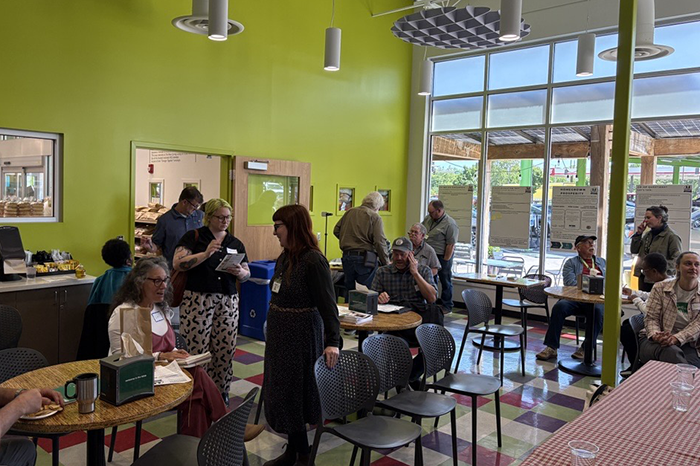
Homegrown Prosperity’s first in-person launch brought 45 people to The Merc Co+op to explore how cooperative business models can help rural communities address shared challenges around market access, farm viability, food infrastructure, succession, processing capacity and community wealth.
Convened by Kansas Farmers Union, Missouri Farmers Union and Common Ground Producers and Growers in partnership with NCBA CLUSA, the event connected farmers, cooperative leaders, public agencies, legislators, agricultural organizations, financial and community institutions, and local food system partners from Kansas and Missouri.


The event marked an important milestone for Homegrown Prosperity. Before gathering in person, the initiative had built awareness through three virtual events and outreach and advertising publications designed to introduce the program, reach rural producers and partners, and invite broader participation. The Merc Co+op launch created the first opportunity to bring this network together face-to-face, strengthen relationships and move from outreach to action.
Structured as a noon–7 p.m. open house, the program included welcome remarks, cooperative panel conversations, networking, a tour of The Merc, open-house learning stations, one-on-one consulting and a closing sign-up and wrap-up session. Participants explored cooperative basics; whether a co-op might be the right fit for them; how co-ops solve challenges that individuals cannot solve alone; and pathways for starting, strengthening or adapting cooperative models.
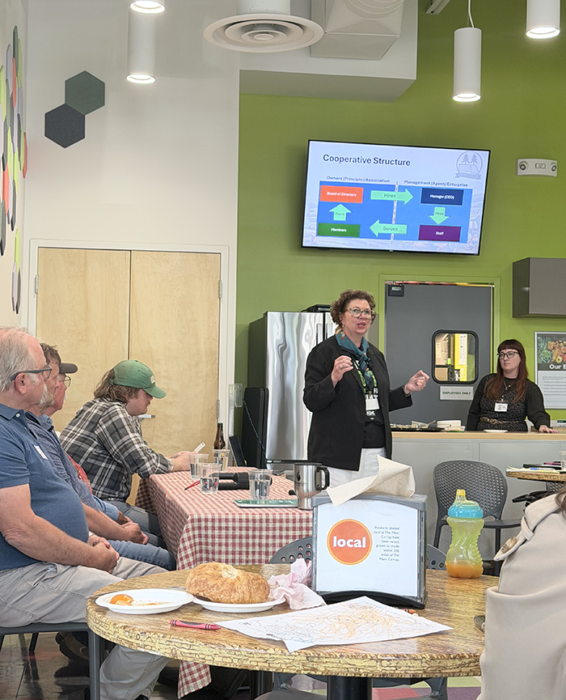 Throughout the day, participants were introduced to the customized Homegrown Prosperity online tool developed specifically for this initiative. This tailor-made resource gives farmers, producers and community partners a practical entry point for exploring whether a cooperative model may fit their goals. Rather than offering a one-size-fits-all approach, the tool supports Homegrown Prosperity’s hands-on incubation process by helping groups begin clarifying their shared challenge, level of readiness, business opportunity and next steps for technical assistance.
By the close of the event, three groups had been identified for cooperative incubation assessment:
- Elderberry farmer group These farmers are seeking to organize cooperatively to gain market share and strengthen their collective position.
- Small and aging farmer group This group of small farmers is exploring cooperative work-conversion or shared operating models while aging farmers are operating at about 60 percent of production capacity.
- Bauman’s Processing Bauman’s Processing is exploring the formation of a meat processing cooperative to increase resilience, expand shared capacity and better absorb market shocks.
These early opportunities demonstrate how education, relationship-building and technical assistance can quickly translate into a pipeline of practical cooperative development work.