
 There’s only one week left until the launch of the Foundations of Cooperative Enterprise Series, a new professional development program designed specifically for cooperative employees, entrepreneurs and emerging leaders!
To help cooperatives invest in their workforces and prepare for the future, the National Cooperative Business Association (NCBA) has partnered with Arizona State University’s W. P. Carey School of Business to co-develop this exciting new program.
The program, which is online and self-paced, combines the cooperative expertise of NCBA with the academic excellence and workforce education capabilities of Arizona State University, creating a flexible learning experience that helps participants build practical knowledge while balancing the demands of their day-to-day responsibilities.
Voices from the Field
“What excites me most about this new program is that it includes interviews with cooperative leaders—including many of our members—from across the country and in different sectors,” NCBA’s Director of Cooperative Engagement and Member Outreach Virginia Brown said. “Their perspectives and experiences provide learners with rich, real-world examples that enhance the academic content of the program.”
Speakers include:
- Weaver Street Market General Manager James Watts about the beauty and challenges that come with managing a multi-stakeholder grocery cooperative
- Pachamama Coffee Cooperative CEO Thaleon Tremain about what it means to have a vertically integrated structure and how this impacts the farmer owners of the co-op
- SECO Energy CEO Curtis Wynn about how rural electric cooperatives provide value to their member-owners
- Keystone Cooperative Development Center Executive Director Noemi Gizspenc about what the 7 Cooperative Principles look like in action
- Jason Wiener | p.c. Founding Partner Jason Wiener on cooperative law and policy insights
The Foundations of Cooperative Enterprise Series begins with four stackable micro-credentials that provide a comprehensive introduction to cooperative enterprise:
- Cooperative Identity and How Cooperatives Work
- Cooperative Law and Public Policy
- Why Cooperatives Form
- Cooperative Models Across Sectors
Together, these micro-credentials provide participants with a deeper understanding of cooperative identity, governance, ownership structures, public policy and the economic principles that make cooperatives unique. Micro-credentials are accessibly priced at $125 each. Learners who complete all four micro-credentials are eligible to enroll in the capstone—a live, faculty-led experience that connects academic concepts with practical experience and workplace applications. Those who complete all four micro-credentials plus a separately-priced capstone earn course credit for just $1,065.

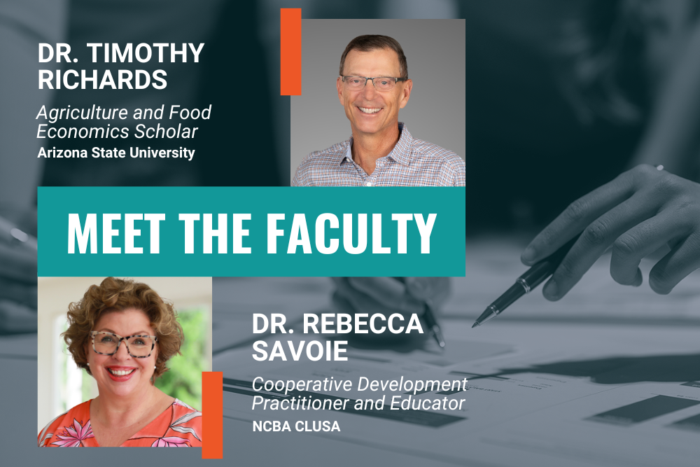
Meet the faculty
The faculty teaching these microcredentials bring complementary academic and applied expertise. ASU’s renowned Dr. Timothy Richards is a leading scholar in agricultural and food economics, with decades of teaching and research focused on agricultural markets, agribusiness and the economics of agricultural cooperatives. His extensive research brings a strong economic and analytical foundation to the series and helps learners understand not only how cooperatives operate, but why they form and the economic conditions under which they can create value.
He is joined by NCBA’s Dr. Rebecca Savoie, a cooperative development practitioner and educator with more than 20 years of experience working with cooperatives, businesses and development organizations in the U.S. and internationally. Rebecca previously served as NCBA’s Cooperative Development Practice Area Director and, more recently, as a Senior Researcher with the International Cooperative Research Group. She has led cooperative and agribusiness development initiatives primarily across Africa, with additional experience in Latin America and Asia. Her expertise spans cooperative governance, enterprise development, agribusiness and cooperative education and training. She is currently supporting several of NCBA’s U.S.-focused cooperative and rural development initiatives.
“Partnering with ASU to develop the Foundations of Cooperative Enterprise Series has been an incredible opportunity,” Dr. Savoie said. “We’ve brought together academic expertise, applied experience and voices from the field to explore the issues shaping cooperatives today. The micro-credential model allows us to make that knowledge practical, accessible and affordable—and relevant to the real-world opportunities and challenges facing cooperative enterprises.”
“The micro-credential model allows us to make [co-op] knowledge practical, accessible and affordable—and relevant to the real-world opportunities and challenges facing cooperative enterprises.” – Dr. Rebecca Savoie
Learn more
Enrollment is now open for the Foundations of Cooperative Enterprise Series, and the first four micro-credentials go live on August 20. Co-ops looking to invest in emerging leaders and strengthen cooperative knowledge and culture across their teams are encouraged to explore the program and secure spots for employees now.
Reach out to our team if you’d like to schedule a meeting or take advantage of NCBA member discounts.