
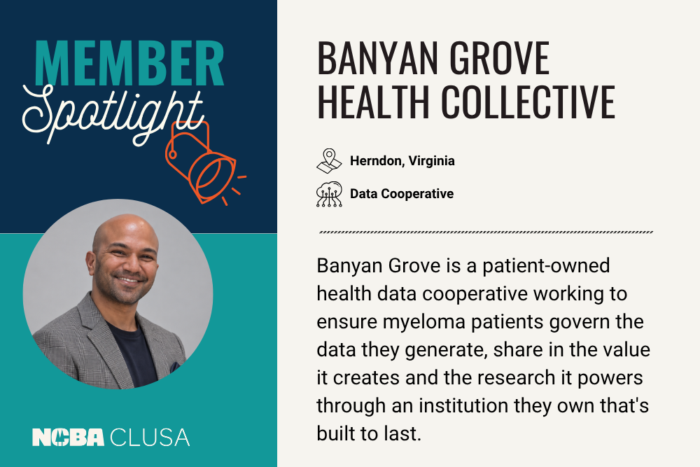
 In a healthcare system increasingly shaped by data, some of the people generating the most valuable information—the patients—often have the least control over how that information is used, and NCBA’s newest member Banyan Grove Health Collective is working to change that.
Formed in 2026 as a Colorado public benefit cooperative, Banyan Grove is a patient-owned health data cooperative designed to serve the multiple myeloma community nationwide. Multiple myeloma is a blood cancer affecting nearly 200,000 Americans. Still in its beginning stage, Banyan Grove is preparing to welcome its first members ahead of a public launch later this year, but even before formally launching, it’s offering an ambitious example of how cooperative ownership could reshape the relationship between patients, technology, research and data.
At the center of the model is a straightforward idea: that the people whose health data creates value govern how that data is used. Banyan Grove members will collectively own and govern the cooperative. Adherence to the 2nd Cooperative Principle (Democratic member control) with one member, one vote is central to Banyan Grove’s structure. Members will have a say in who is permitted to use cooperatively held data, how that data can be used, and how the value generated from it should benefit the community. That value could ultimately return to members through dividends or be reinvested in the cooperative’s technology, services and cancer research.
For Banyan Grove founder and myeloma patient Dhruv Deepak, the cooperative model provides an opportunity to address a longstanding imbalance in healthcare.
“I’m a myeloma patient myself. In the blur of my tests, procedures and therapy regimens, I was never given the opportunity to consider what data is being collected from me versus what I wanted shared, who has looked at my data and why, whether that data has been commoditized and sold, and how the value it creates comes back to me. It is safe to say that these concerns ail the broader digital economy as well,” he said. “Banyan Grove is how we change that, by allowing patients to own and make decisions about their data, in accordance with their rights and interests.”
“Banyan Grove is how we change that, by allowing patients to own and make decisions about their data, in accordance with their rights and interests.” – Dhruv Deepak, Founder
That ownership structure also creates protections that extend beyond participation in individual research projects. Because members own the institution holding and governing the data, the cooperative itself cannot simply be purchased and transferred away from the people it was created to serve.
Accessibility is another central part of the model. A one-time $42 membership investment makes a patient an owner of the cooperative. Members will also be able to sponsor memberships for patients who cannot afford the buy-in, helping ensure that financial circumstances do not prevent someone from having a voice in the institution.
While Banyan Grove is focused initially on the multiple myeloma community, its founders see a much larger opportunity for the cooperative sector.
Health data remains an emerging frontier for cooperative ownership, and Banyan Grove is being intentionally designed so its infrastructure and governance approach could eventually be adapted by other patient communities. Its name reflects that long-term vision: like a banyan tree that extends aerial roots outward to form new trunks, one successful cooperative could help seed a broader network, or grove, of patient-owned data institutions.
The project is also deeply rooted in the broader cooperative movement. Fellow NCBA member Start.coop serves as Banyan Grove’s fiscal sponsor, and the cooperative’s design draws from years of doctoral research examining platform cooperatives and how communities can build and govern their own data institutions.
That work has also included engagement with people and organizations connected to the Platform Cooperativism Consortium. Rather than treating cooperative ownership as an overlay on an existing technology company, Banyan Grove is building governance into the foundation of the institution from the beginning. As conversations about artificial intelligence, healthcare technology and data ownership accelerate, cooperatives may have an increasingly important role to play in answering a fundamental question: who should benefit from the information communities collectively create?
That is part of what makes Banyan Grove a cooperative to watch.
Joining NCBA represents another step toward embedding the young organization within the wider cooperative ecosystem.
“We joined NCBA because a cooperative shouldn’t build alone,” Deepak says. “We’re new at this, and we want to learn from the movement and give back to it as we go.”
“We joined NCBA because a cooperative shouldn’t build alone. We’re new at this, and we want to learn from the movement and give back to it as we go.” – Dhruv Deepak, Founder
For established cooperatives, emerging entrepreneurs and organizations exploring the intersection of technology and member ownership, Banyan Grove’s development may offer lessons well beyond healthcare. And for the cooperative itself, those conversations are welcome. Banyan Grove is especially interested in connecting with cooperatives exploring data, governance and member ownership—particularly those working at the intersection of health and technology.
As the cooperative prepares for the next steps, it is beginning with an idea deeply familiar to the movement: institutions can work differently when the people most affected by them are also the people who own them.