
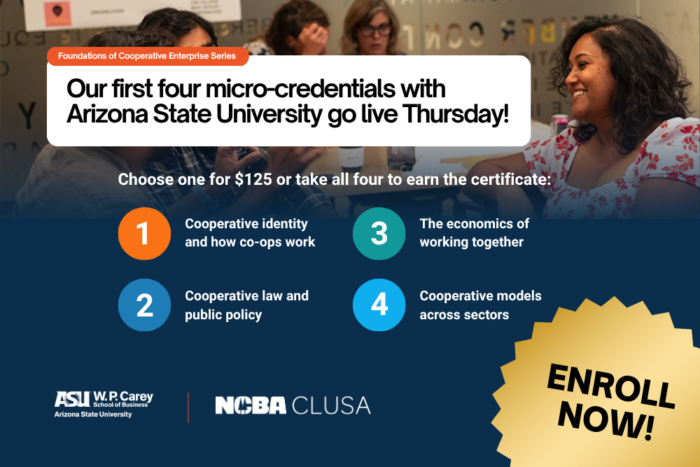
 Are you ready to build your cooperative business expertise?
NCBA is thrilled to announce that we’re teaming up with Arizona State University’s W. P. Carey School of Business to launch the Foundations of Cooperative Enterprise Series—a new professional development program designed specifically for cooperative employees, entrepreneurs and emerging leaders.
The first four micro-credentials in this series go live tomorrow, August 20. There are no prerequisites or big commitments required to get started. In fact, you can enroll now for as low as $125.
Each micro-credential is a standalone course you can put to work right away. Take one to build a specific skill, or complete all four to earn the Foundations of Cooperative Enterprise professional certificate.
Whether you’re new to cooperatives or preparing for your next leadership opportunity, our online, self-paced program can help you level up your skills and take the next step in career.
Keep reading to learn more about our first four micro-credentials. And check out the learning journey in the graphic below. Learners who complete all four micro-credentials unlock a capstone experience. This live, faculty-led project integrates the concepts, frameworks and tools developed across the four micro-credentials to address a real-world cooperative challenge or opportunity.

About the micro-credentials
Cooperative identity and how co-ops work
Build a strong foundation in cooperative identity and understand how cooperatives operate across industries and around the world. By the end of this course, you’ll be able to:
- Describe the foundational elements of cooperative identity
- Explain how cooperatives differ from investor-owned firms
- Identify key features of member ownership and governance
- Recognize different cooperative organizational models
- Summarize the role of cooperatives across sectors and regions

Cooperative law and public policy
Examine the legal and policy environments that shape how cooperatives operate and grow. By the end of this course, you’ll be able to:
- Describe legal frameworks that define cooperative organizations
- Explain how public policy influences cooperative development
- Identify key differences between cooperative and investor-owned structures
- Recognize how regulation affects governance and access to capital
- Summarize policy impacts on cooperative competitiveness and viability
The economics of working together
Understand the economic conditions that drive cooperative formation and when cooperative models are appropriate. By the end of this course, you’ll be able to:
- Identify economic conditions that motivate cooperative formation
- Explain market failures, power imbalances and information asymmetries
- Recognize when cooperative solutions may be appropriate
- Describe key economic concepts used in cooperative models
- Assess how cooperatives respond to market challenges
Cooperative models across sectors
Explore how cooperative models vary across sectors, from agriculture and finance to housing and energy. By the end of this course, you’ll be able to:
- Compare cooperative models across multiple sectors
- Describe strengths and limitations of difference cooperative structures
- Explain how membership type influences cooperative design
- Identify emerging and hybrid cooperative forms
- Recognize how cooperatives adapt to market and technological change
Discounts for NCBA members
NCBA members are eligible for an exclusive discount on enrollment. Email [email protected] for details.