
What Is A Co-Op?
The person or people who own a business determine the type of entity it is. When an individual owns and operates a company, it’s often a sole proprietorship. When two or more people own a company, it’s often a partnership. A company can incorporate, forming a corporation that is owned by fewer than 100 people (an S-corp) or hundreds or even thousands of people (a C-corp).
When the people who use the products and services a company has to offer also own and operate the company, it’s known as a cooperative. Aside from the ownership structure, there are a few other distinct features that set cooperatives apart from other types of business.
The International Co-Operative Alliance defines a cooperative, or co-op, as “an autonomous association of persons united voluntarily to meet their common economic, social, and cultural needs and aspirations through a jointly-owned and democratically controlled enterprise.” In other words, cooperatives are created by people who have a specific need and who are willing to work together to operate and organize a company that will meet that need.
For example, consider rural electric cooperatives (RECs). Some large city power companies may not see running electricity lines to farms and rural areas as a profitable venture. As a solution, farmers might form a cooperative to collectively raise or borrow funds to construct and govern a not-for-profit, private power utility. Every property that uses the power utility becomes a member-owner of the REC, contributing to the management, decisions and maintenance of the utility co-op. This cooperative focuses on improving the community’s quality of life rather than making a profit. Today, RECs power 56% of the American landscape.
How Do Cooperatives Work?
A cooperative might look very similar to any other type of corporation. For example, if you were to visit a grocery store cooperative, it is very likely that it will look like any other grocery store. There will be aisles full of food and checkout registers where people can make their purchases.
But if you were to look more closely, or take a peek behind the scenes, you’d be likely to notice that the food co-op operates slightly differently from a typical grocery store. For one thing, it’s likely that the people who are members of the cooperative, or part-owners of the co-op, are also working at the co-op, stocking the shelves and ringing customers up at the register.
Plus, some cooperatives limit who can shop there or use their services. In some cases, only members of a cooperative can shop at it. Some cooperatives are open to all, but provide special incentives to members, such as a discount on products or services.
Why are people who are members of a food co-op willing to volunteer or donate their time to work at the co-op? In part because of the community focus of a cooperative and the values behind co-ops. Among those values are:
- Democracy
- Self-help
- Self-responsibility
- Equity
- Equality
- Solidarity
People who join cooperatives or who are among the founding members of a co-op often have the same shared values, meaning they are willing to work together toward a common goal. One of those goals is to create a better world by working together and by shifting the focus of the business to place people over profit to build a more inclusive economy.
What Is the Purpose of a Co-Op?
Why do co-ops exist? The purpose of a cooperative is to realize the economic, cultural and social needs of the organization’s members and its surrounding community. Cooperatives often have a strong commitment to their community and a focus on strengthening the community they exist in or serve. When a co-operative does well financially or economically, the community served by the co-op benefits, not just a small group of shareholders.
Co-Op Ownership and Control
The people who benefit from the products or services of a cooperative business own the cooperative business. In the case of a grocery co-op, the people who shop at the store are owner-members. In the case of co-op housing, the people who live in a particular building are members of the cooperative that owns the building.
Just as the stockholders or shareholders of a business have a say in the ownership and operations of a company, the member-owners of a co-op have a say in how the cooperative operates. The difference is that in other types of corporations, the size of their ownership stake influences how much of a say or how much control an owner has over the company. A shareholder who owns 50% of a corporation will have more votes or more control over the operation of the company compared to a shareholder who owns 2% of a corporation.
That’s not the case with a co-op. As equity and equality are among the founding principles of a cooperative, each member-owner of a co-op gets one vote. The opinion of one co-op member does not have more weight than the opinion of another co-op member.
Cooperatives often elect a board of directors. The responsibilities of the co-op board include ensuring that the cooperative is working toward achieving its mission, setting up operational policies for the co-op and hiring any outside managers or other employees.
Members of a co-op’s board are members of the cooperative itself. They are typically elected to the board by a member vote. Some board members also serve as officers, such as president, vice president, secretary and treasurer. Board officers have additional responsibilities and duties, which members can find in the cooperative’s by-laws.
Cooperative Business vs. Traditional Business
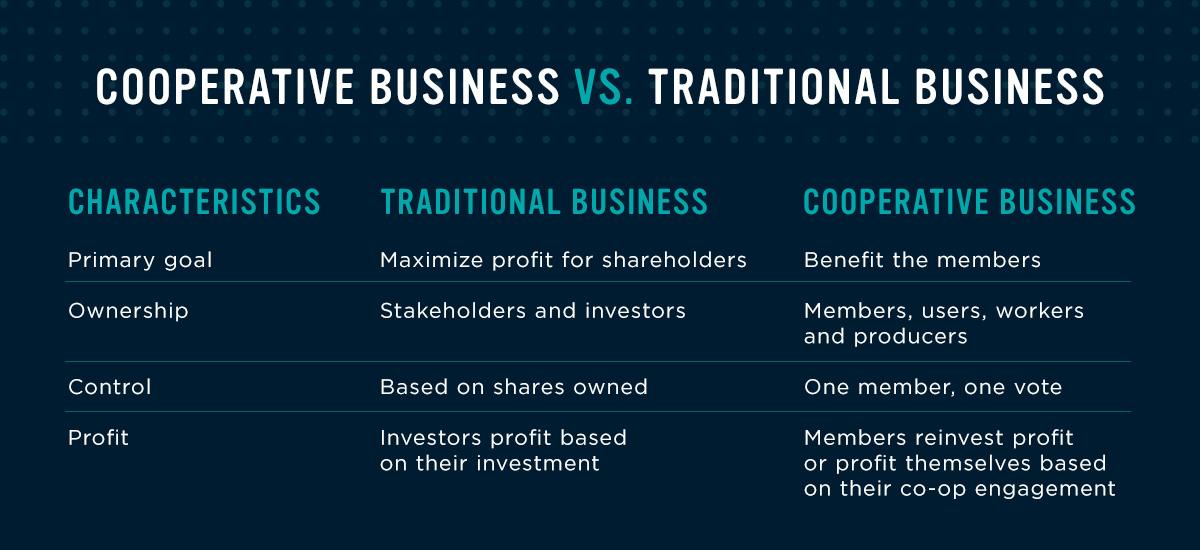
To understand the differences between a cooperative business and a traditional business, the table below summarizes the key characteristics of each model.
| Characteristics | Traditional Business | Cooperative Business |
|---|---|---|
| Primary goal | Maximize profit for shareholders | Benefit the members |
| Ownership | Stakeholders and investors | Members, users, workers and producers |
| Control | Based on shares owned | One member, one vote |
| Profit | Investors profit based on their investment | Members reinvest profit or profit themselves based on their co-op engagement |
This structural difference indicates a movement in a business’s purpose. Traditional businesses are designed to give value to stakeholders or investors, while cooperatives keep value within the community. By placing members like you at the center of its operations, the co-op remains a system that serves the community rather than the community serving the system.
7 Cooperative Principles
The International Cooperative Alliance adopted seven cooperative principles in 1995. These guiding values are based on a set of principles known as the Rochdale Principles, which were first created in 1844. The cooperative principles create guidelines for co-ops to follow and allow co-ops to put their values into action.
- Voluntary membership: Any person who is willing to accept the responsibilities of co-op membership and who wishes to use the services of a cooperative is welcome to become a member.
- Democratic member control: Co-ops are controlled by their members. Members have control over setting policies for the co-op and making decisions for the cooperative.
- Member economic participation: Members contribute to the capital of the co-op democratically and equitably. Most of the capital of a co-op remains the property of the co-op and isn’t redistributed to members.
- Autonomy and independence: Co-ops are meant to be autonomous and democratically controlled, meaning they aren’t subject to control by outside organizations.
- Education, training and information: A cooperative provides education and training to members and board members to allow them to contribute to the development of the co-op. Cooperatives also seek to inform and educate the public about the mission and operation of a co-op.
- Cooperation among cooperatives: Co-ops will often work together, creating regional, national and international structures that help to improve the community and create a better world.
- Concern for community: The policies approved by the members of a cooperative should help to develop the community around the co-op in a sustainable way.
What Types of Cooperatives Are There?
Cooperatives can be large or small, can exist in a range of industries or sectors and can take multiple forms, based on who the member-owners of the co-op are. A few examples of cooperative types include:
- Worker co-ops: The people who work for the company own a worker co-op. Workers contribute to the cooperative through their labor and the work they do for the organization. Although worker co-ops can be in any industry or sector, many are in the retail and service industries.
- Farmer and Independent Small Business Co-ops: Farmer and independent small business cooperatives are corporations in which the people who use their services have control over the company, and the business serves members’ purchasing, processing and marketing needs. Organic Valley is an example of a farmer and independent business co-op.
- Purchasing co-ops: Purchasing co-ops are several small businesses that have joined together to improve their purchase power and to get better discounts and offers on products and services.
- Processing co-ops: Processing co-ops add value to the commodities a business produces through the collective ownership of the processing equipment.
- Producer co-ops: The producers of products who have joined together to market their products better or streamline the production process own produce cooperatives. Agriculture cooperatives such as Blue Diamond or Land O’Lakes are examples of producer cooperatives.
- Consumer co-ops: Customers who purchase goods and services from the cooperative own a consumer co-op. Grocery co-ops are a well-known example of consumer cooperatives.
- Hybrid co-ops: A hybrid cooperative combines the two models of a consumer-worker cooperative with cooperatives that focus on workers in the freelance economy. Examples of a hybrid co-op include Cenex Harvest States Cooperatives and Weaver Street Market.
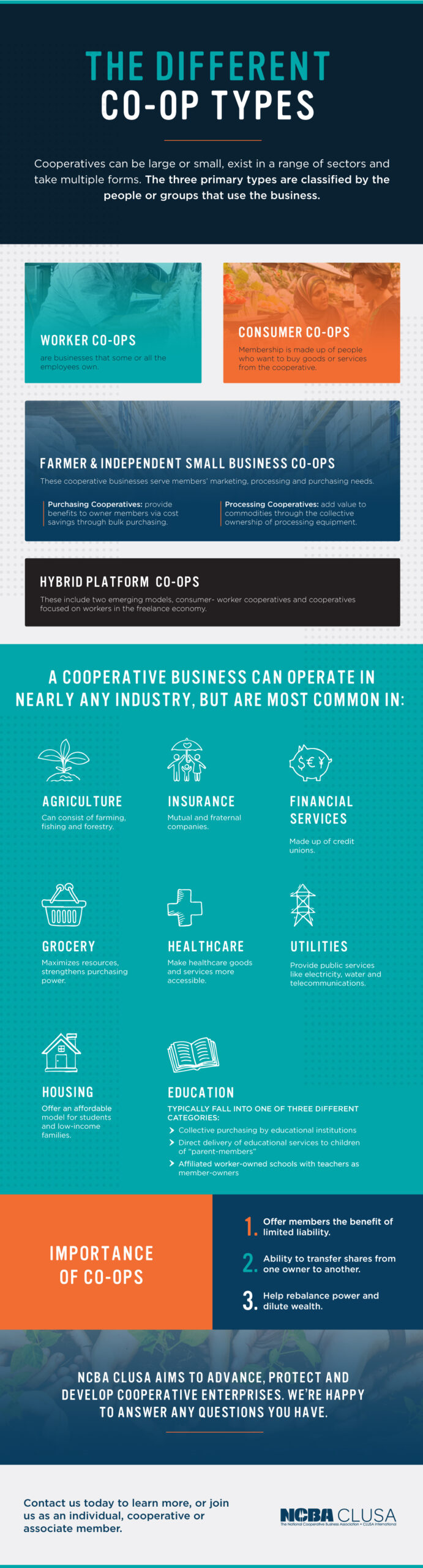
A cooperative business can operate in nearly any industry or sector, but you are more likely to see co-ops in the following areas:
Agriculture
Agricultural co-ops have been in existence for centuries. In early agricultural cooperatives, members pooled their resources to help farmers secure land and supplies. Today, more independent farms are beginning to work together to achieve long-term success. Some examples of agriculture cooperatives include Sunkist Growers Inc. and Tillamook County Creamery Association.
Insurance
Insurance co-ops function in two ways. The first is through cooperative insurance that fully covers all co-op members. The second is through insurance companies that apply the co-op business model. With the cooperative business model in place, organizations such as the National Association of Mutual Insurance Companies and the International Cooperative Alliance can focus on policyholders to provide full coverage at a reasonable cost.
Financial Services
Financial services co-ops such as a credit union help to strengthen the economy by granting account members ownership over the financial institution. Account members receive the revenue they earn as owners through higher dividends, fewer fees and low-interest rates. National and international organizations such as Credit Union National Association and World Council of Credit Unions work to promote the mission of cooperative financial institutions.
Grocery
In a grocery co-op, the customers are the owners and can purchase shares to participate in decision-making and receiving profits. However, everyone is welcome to shop at a grocery co-op without being a member. Grocery cooperatives help their communities by giving money back to the local community through their employees, members and neighbors. Examples of grocery cooperatives include National Co-op Grocers and the Neighboring Food Co-op Association.
Education
Education co-ops exist at the early education levels all the way up to undergraduate programs. A preschool education cooperative allows parent members to determine policies and serve on committees to reduce costs. Many universities, such as Cornell University, also offer a co-op education program where students gain professional experience for course credit.
Healthcare
Healthcare cooperatives do not pursue profit to help patients save money on their medical bills and insurance. As more patients join a cooperative healthcare plan, the cost spreads out among more members, and the amount each patient has to pay goes down. Healthcare co-ops exist worldwide, and many cooperative alliances such as Cooperatives for a Better World work to support and defend the co-op business model.
Housing
In many major cities, housing co-ops are apartment complexes, single-family homes, mobile home parks or student housing that empower people with homeownership and responsibility. Each resident is a stakeholder with a particular focus on the needs and interests of the group. Many U.S and international associations advocate and promote housing cooperatives such as Co-operative Housing International.
Utilities
Utility and energy co-ops help local communities by managing public services such as electricity, water and telecommunications. Each member is a shareholder and can express an opinion about the governance and delivery of services. Examples of utility co-ops include organizations such as A&N Electric Cooperative and Basin Electric Power Cooperative.
The History of Co-Ops in the U.S.
Cooperatives have been organized for well over 300 years. Throughout history, this business model has allowed early communities to join forces during times of economic and social difficulty to meet their common needs and thrive.
The foundation of the U.S. cooperative landscape stems from the turmoil of the Industrial Revolution in England from 1750 to 1850, when mutual aid organizations formed to address the stressful conditions of the time. However, the Rochdale Equitable Pioneers Society, established in 1844, is considered the founder of the cooperative movement.
The earliest recorded successful cooperative in the U.S. was founded in 1752 by Benjamin Franklin and community firefighters in Philadelphia. This cooperative is known as the Philadelphia Contributionship, a mutual fire insurance company that insured homes lost to fire. This cooperative still operates today and is the oldest property insurance company in the nation.
From here, the cooperative movement flourished into other sectors and industries:
- The first recorded dairy cooperatives were organized in 1810, followed shortly by cooperatives for other agricultural commodities.
- The First Workingmen’s Protective Union began in 1845, organizing bulk programs for its co-op in Boston.
- The Order of the Patrons of Husbandry, also known as the Grange, was founded in 1867 to combat low agricultural prices and high costs. It’s the oldest agricultural advocacy organization in the U.S.
- The Cooperative League of the United States of America (CLUSA), now known as NCBA CLUSA, was organized in 1916 to advance the cooperative movement.
Why Co-Ops Matter Today
Co-ops offer multiple benefits to their members and the community around them. From a business point-of-view, cooperatives offer their members the benefit of limited liability. If the co-op should have financial difficulties or accused of wrong-doing, the individual member-owners are not personally responsible for the problems faced by the cooperative.
The structure of a co-op means that it can transfer shares from one owner to another. If a member moves out of the area, dies or no longer wants to be part of a cooperative, they can sell their stake or membership in the co-op to someone else. The cooperative itself will survive even once all of the original members have moved on.
From a social justice and democratic point-of-view, cooperatives matter today because they help to rebalance power and dilute the concentration of wealth. In the U.S., the top 1% households hold 31.7% of all U.S. wealth as of 2025. The cooperative model creates shared prosperity, allowing more people to participate in the economy. Instead of a few people owning the bulk of every business, ownership resides with the people.
As the cooperative model uses the concept of “one member, one vote,” it also helps to level the playing field. People don’t get to have more of a say or more power simply because they happen to own a more significant portion of a company.
The cooperative model is also proving to be beneficial for the growth of small businesses in the U.S. Turning privately-held businesses into worker co-ops not only benefits the employees of those companies, who become the owners of the businesses that employ them, but it also benefits the businesses themselves. Cooperatives are more resilient in fluctuating economies and have higher productivity levels than other business models.
Co-Op Trends and the Future
In 2024, the United Nations General Assembly announced 2025 as the International Year of Cooperatives under the theme “Cooperatives Build a Better World.” The vision of this movement emphasizes the crucial role of cooperatives in promoting sustainable development, supporting inclusive economic growth and phasing out poverty. Co-ops are the driving force behind fulfilling the UN’s Sustainable Development Goals by 2030.
With the theme in mind, co-ops are focusing on strengthening their presence by adapting to current economic challenges. This shift has sparked a wave of co-op trends expected to evolve over the next few years, supporting the co-op’s future as it builds an inclusive economy.
Platform Cooperatives
A platform cooperative is a digital environment that’s owned and operated by individuals who rely on and participate in it to sell their products or services. These platforms can be websites or apps, bringing the cooperative business model online.
Platform cooperatives can be found in industries such as transportation, photography, labor, journalism, music, healthcare and marketplaces.
Examples of platform cooperatives include:
- Green Taxi Cooperative: A driver-owned taxi cooperative located in Denver.
- Stocksy United: An artist-owned cooperative for stock photography and video.
- Resonate: A music streaming service that operates on a “stream to own” method.
- Fairbnb: A community-focused alternative to Airbnb.
Green Co-Ops
Green co-ops prioritize environmental sustainability and protection and range from food co-ops and worker-owned green businesses to renewable energy, recycling and housing. In the face of global issues such as climate change and pollution, green co-ops aim to promote more sustainable ways of living to protect the planet.
Examples of sustainability-focused cooperatives include:
- Recycled Products Cooperative: Dedicated to natural resource conservation through recycling.
- Evergreen Cooperative Laundry: An industrial-scale green laundry service.
Community Wealth Building
Typically, in traditional business models, wealth is extracted from communities and transferred to companies and shareholders. Community wealth building does the opposite.
Community wealth building is people-centered and aims to redirect wealth back into the community and address inequality. This approach focuses on local economic development and resilience and allows the community to control and benefit from its assets. Empowering communities by promoting equality and fairness improves locals’ lives and builds toward a better world.
Inter-Cooperation
To promote the positive impact cooperatives have on communities and quality of life, co-ops are joining forces. These partnerships are known as inter-cooperation and involve a collaboration between various organizations, industries and countries to enhance economic, social or political improvement.
They achieve these goals through large-scale infrastructure projects and bilateral tax agreements. Inter-cooperation allows joint action on global challenges, resource sharing and harmonized policies.
The Benefits of Cooperatives
The benefits of cooperatives are visible across multiple areas. NCBA CLUSA, the Cooperative Development Foundation and the Urban Institute worked together to identify seven areas where the benefits of the cooperative structure have the most impact. The organizations dubbed those seven areas the “ABCs of Cooperative Impact.”
Among the measurable benefits and areas of impact are:
- Access: Co-ops make certain products or services that would otherwise be out of reach accessible to certain markets or communities.
- Business sustainability: The cooperative structure can make a business more stable and help a company work through rough patches.
- Community commitment: Co-ops commit to their local community and will often work to uphold the values of a community through financial services, educational programs or business practices.
- Democratic governance and empowerment: Because co-ops are democratic, they often help to increase people’s civic involvement.
- Equality, diversity and inclusion: Voluntary membership means that cooperatives are often accurate reflections of the diversity of a community. Voluntary membership also makes co-ops inclusive organizations.
- Financial security and advancement for workers: Cooperatives often serve the needs of their members by providing worker-members with living wages, the ability to move up the career ladder and financial stability.
- Growth: By offering high-quality products and services, good jobs and investing in a local community, co-ops can grow and promote growth in the community they serve.
Navigating Challenges and Ensuring the Success of Cooperatives
While the cooperative business model offers numerous advantages, it’s essential to acknowledge and proactively address potential challenges. By anticipating these hurdles and implementing effective strategies, co-ops can foster resilience and achieve long-term success.
Internal organizational strategies may include:
- Securing financial resources: While raising capital can be a hurdle, co-ops can explore diverse funding options, including member contributions, community loan funds and partnerships with socially responsible investors.
- Streamlining decision-making: To mitigate slow decision-making, co-ops can implement clear governance structures, delegate authority to committees and use technology for efficient communication and voting processes.
- Managing complex operations: Encouraging open communication and fostering a culture of inclusivity can help co-ops navigate diverse member interests and maintain participation.
- Scaling effectively: As co-ops grow, maintaining member engagement and control is essential. Strategies such as tiered membership models and online platforms can facilitate communication and participation on a larger scale.
- Ensuring continuity: Proactive leadership planning, mentorship programs and knowledge transfer initiatives can ensure the co-op’s long-term sustainability and adaptability.
External market-related strategies might involve:
- Expanding market access: Cooperatives can overcome limited market access by using online platforms and forming strategic alliances with other businesses to reach broader customer bases.
- Optimizing supply chains: Agricultural co-ops can mitigate supply chain restrictions by investing in improved storage facilities, transportation infrastructure and collaborative partnerships to minimize losses.
- Diversifying funding sources: To reduce dependency on grants, co-ops can explore alternative funding models, such as crowdfunding.
- Adapting to regulatory changes: Staying informed about evolving regulations and engaging in advocacy efforts can help co-ops promote a supportive policy environment.
The Stats on Co-Ops in the United States
Around the world, there are about 3 million cooperatives, and more than 1 billion people are members of a co-op. About 10% of the world’s population, or around 280 million people, are employees at co-ops. In the United States, there are around 65,000 cooperative establishments, and one out of every three people is a member of a cooperative.
The number of co-ops in the U.S. varies by sector and type. For example, there are between 300 and 400 worker-cooperatives in this country. Worker co-ops employ around 7,000 people and produce in the neighborhood of $400 million in annual revenue.
In the financial services sector, there are 4,370 federally insured credit unions as of 2025. Millions of Americans are credit union customers. Retail co-ops are also popular. REI Co-op, one of the most well-known co-op retailers, has over 24 million members.
Another popular type of cooperative in America is the grocery store co-op. There are hundreds of these co-ops across the U.S. — National Co+op Grocers alone represents 168 food co-ops in 40 states. Grocery cooperatives considerably impact their local economy, as many offer products from local farmers and producers.
Locally produced products make up about 21% of sales at grocery co-ops, compared to less than 2% of sales at supermarkets and grocery stores. Grocery co-ops also make a positive impact on their communities. There are 50 food co-ops that support farm-to-school programs in 50 states, and 39% of National Co+op Grocer member co-ops offer needs-based discounts.
NCBA CLUSA Supports Cooperatives in All Industries
A cooperative focuses on you, the member, who wants to make a difference in your community. Whether it’s powering up your small town with a utility co-op or promoting local farmers through a producer co-op, we can help. The National Cooperative Business Association strives to advocate, educate and protect the cooperative movement across all sectors in the U.S. to build an inclusive economy.
If you have any questions about cooperatives or want to volunteer with us, we’re happy to help and give you insight into the work we do. For more information, contact us today
FAQs
Who can start a co-op?
Anyone can start a cooperative. Co-ops can be created in virtually any industry and at any scale, from a small neighborhood storefront to a multibillion-dollar enterprise. All you need is a group of people with a common need and a willingness to work together. Worker co-ops, consumer co-ops, and producer co-ops are just a few examples of the many different types of cooperative organizations. Co-ops are commonly found in agriculture, grocery, healthcare, housing, financial services, utilities, and worker-owned sectors. NCBA CLUSA offers resources and guides to help aspiring co-op organizers evaluate whether the cooperative model is the right fit, assemble a steering committee, draft bylaws, and formally incorporate.
How does the "one member, one vote" principle work?
In a cooperative, every member has an equal voice, regardless of how much capital they've contributed or how much they purchase. This "one member, one vote" principle is a cornerstone of democratic member control, ensuring democratic governance and promoting member empowerment. Members elect a board of directors to manage the business, set policies, and make key decisions, and each member's vote in those elections carries the same weight. This structure prevents any single person or small group from dominating the organization and ensures that the co-op truly serves the collective interests of its membership, setting it apart from traditional business structures.
How are profits distributed in a cooperative?
Cooperatives don't operate to maximize profits for outside investors. Instead, any surplus (net earnings) is either reinvested back into the business to improve services, allocated to reserves, or returned to members as patronage dividends or patronage refunds, distributed in proportion to each member's use of the co-op rather than based on the amount of capital invested. Members also participate democratically in deciding how surplus funds are used, ensuring the benefits flow back to the people and communities the co-op serves. Patronage refunds may also have tax implications for members.
What are the seven cooperative principles?
The seven cooperative principles, adopted by the International Co-operative Alliance (ICA) in 1995 and rooted in the Rochdale pioneers of 1844, are:
1, Voluntary and Open Membership: Co-ops are open to all who can use their services and accept membership responsibilities. This ensures that co-ops are inclusive and accessible to anyone who needs their services.
2. Democratic Member Control: Members actively participate in setting policies and electing leaders on a one-member, one-vote basis. This principle ensures that the co-op is run by and for its members, not by outside investors.
3. Member Economic Participation: Members contribute equitably to the co-op's capital and share in its benefits. This aligns the financial interests of the members with the success of the co-op.
4. Autonomy and Independence: Co-ops are self-governing organizations controlled by their members. This allows co-ops to make decisions that are in the best interests of their members and communities.
5. Education, Training, and Information: Co-ops provide learning opportunities so members, leaders, and employees can contribute effectively. Informed members make better decisions and contribute more to the co-op's success.
6. Cooperation Among Cooperatives: Co-ops strengthen the movement by working together locally, nationally, and internationally. By collaborating, co-ops can achieve more than they could alone.
7. Concern for Community: Co-ops work for the sustainable development of their communities. This demonstrates that co-ops are not just about profit but also about making a positive impact on the world.